

We are one of the most trusted CCIE Enterprise Infrastructure v1.0 Training institute in Mumbai, India, Octa Networks is providing CCIE Enterprise Training in Mumbai, India. Octa Networks has been at the forefront of training institutes which help and train students to achieve their CCIE certification goals over the last 8+ years. Octa Networks has gained trust and faith of the aspiring CCIEs.

Course Highlights
 Training Mode
Classroom and Online Learning Method
Lecture & Self-Study Duration
2 Months Training Hours
2 Hours per day Hands on Labs
Yes Study Material
Yes Certificate
Yes Batches
Weekdays (Mon-Fri) & Weekend (Sat-Sun) Price
Price
Enquire now


Enquire Now
CCIE Enterprise Infrastructure v1.0 Course overview
We are one of the most trusted CCIE Enterprise Infrastructure v1.0 Training institute in Mumbai, India, Octa Networks is providing CCIE Enterprise Training in Mumbai, India. Octa Networks has been at the forefront of training institutes which help and train students to achieve their CCIE certification goals over the last 8+ years. Octa Networks has gained trust and faith of the aspiring CCIEs.
Cisco has rebooted the Certification program on 24th Feb 2020, by launching CCIE Enterprise Infrastructure v1.0 which replaced CCIE Routing & Switching v5.0. Below are the details of the CCIE Enterprise Infrastructure v1.0 certification:
Implementing and Operating Cisco Enterprise Core Technologies:
- Dual-Stack (IPv4 & IPv6) Architecture
- Virtualization
- Infrastructure
- Network Assurance
- Security
- Automation
CCIE Enterprise Infrastructure v1.0 Lab:
- Network Infrastructure
- Software-defined Infrastructure
- Transport Technologies and Solutions
- Infrastructure Security and Services
- Infrastructure Automation and Programmability
The objective of the CCIE Enterprise Infrastructure blueprint revamp is to cover the most current demands and needs of the industry by taking future technology trends into consideration.
CCIE Enterprise Infrastructure v1.0 blueprint is rebooted to cover the most relevant technologies and business needs by designing a qualifying core exam which covers technologies including Automation and Programmability while the lab exam will validate end-to-end lifecycle skills with complex infrastructure, from planning and design to operating and optimizing.
CCIE Enterprise Infrastructure v1.0 bootcamps and focused training facilities are made available by Octa Networks across India. We are proud of our track record of guiding and coaching our students to achieve their CCIE certifications. We provide the best CCIE Enterprise Training in Mumbai, India and we will continue our efforts to aim towards being the best CCIE training institute in India.
CCIE Enterprise Infrastructure v1.0 Certification Course Details
Prerequisite
- There are no formal prerequisites for taking the CCIE Enterprise Infrastructure lab exam but should have a thorough understanding of the exam topics before taking the exam.
- CCIE candidates are recommended to have five plus years of experience with designing, deploying, operating and optimizing enterprise networking technologies and solutions prior to taking the exam.
- ENCOR 350-401 (Implementing and Operating Cisco Enterprise Network Core Technologies) is the qualifying exam for CCIE Enterprise Infrastructure and CCIE Enterprise Wireless certifications. Please refer to the CCNP Enterprise certification page for ENCOR 350-401 exam details.
Course Duration
- 2 months of Instructor-led classroom training
- 2 months of instructor-led online training
Who should enroll?
- Network engineers with Core exam - Implementing and Operating Cisco Enterprise Network Core Technologies (ENCOR 350-401). This is the CCIE Enterprise Infrastructure v1.0 written exam which is valid as a qualifying exam for CCIE Enterprise Wireless certification too.
- Network engineer with at least five to seven years of professional experience with designing, deploying, operating and optimizing enterprise networking technologies.
- Network engineers need to use an expert-level problem-solving process that includes options analysis to support complex network technologies and topologies.
- Network designers that design and support complex network technologies and topologies.
- Students and professionals in the IT and Technologies sector who wish to enhance their knowledge and acquire an internationally recognized professional certification which can improve their job prospects.
What jobs are available after the course?
- Sr. Enterprise network engineer
- Lead Consulting systems engineer
- Sr. Technical solution architect
- L3 Network designer
What is CCIE Enterprise Infrastructure v1.0 Course Curriculum?
To be a certified CCIE Enterprise Infrastructure, one must pass two exams: Enterprise Network Core (ENOR 350-401) exam and 8-hour CCIE Enterprise Infrastructure v1.0 lab exam.
- The Enterprise Network Core exam focuses on your knowledge of enterprise networking infrastructure. The core exam is also the qualifying exam for CCIE Enterprise Infrastructure
- CCIE Enterprise Infrastructure v1.0 lab exam covers the end-to-end lifecycle of complex enterprise networks, from designing and deploying to operating and optimizing.
What you’ll learn in this course?
- Configure, troubleshoot, and manage enterprise wired networks
- Configure, troubleshoot, and manage enterprise wireless networks
- Implement security principles within an enterprise network
- Overlay network design by using solutions such as SD-Access and SD-WAN
Duration
- 1 month of Instructor-led classroom training
- 1 month of instructor-led online training
Prerequisites
Knowledge and skills you should have before attending this course:
- Implementation of Enterprise LAN networks
- Basic understanding of Enterprise routing and wireless connectivity
- Basic understanding of Python scripting
How you'll benefit?
This course will help you:
- Configure, troubleshoot, and manage enterprise wired and wireless networks
- Implement security principles within an enterprise network
- Prepare to take the 350-401 Implementing Cisco Enterprise Network Core Technologies (ENCOR) exam
What to expect in the exam?
- 350-401 ENCOR exam tests your knowledge to configure, troubleshoot, and manage enterprise wired and wireless networks, overlay network such as SD-Access, SD-WAN and security principles within an enterprise network
- After you pass 350-401 ENCOR, You earn the Cisco Certified Specialist – Enterprise Network Core Technologies certification.
- You satisfy the core requirement for the new CCNP Enterprise certification. To complete your CCNP Enterprise certification, pass any one of the concentration exam.
Training Outline
- Examining Cisco Enterprise Network Architecture
- Understanding Cisco Switching Paths
- Implementing Campus LAN Connectivity
- Building Redundant Switched Topology
- Implementing Layer 2 Port Aggregation
- Understanding EIGRP
- Implementing OSPF
- Optimizing OSPF
- Exploring EBGP
- Implementing Network Redundancy
- Implementing NAT
- Introducing Virtualization Protocols and Techniques
- Understanding Virtual Private Networks and Interfaces
- Understanding Wireless Principles
- Examining Wireless Deployment Options
- Understanding Wireless Roaming and Location Services
- Examining Wireless AP Operation
- Understanding Wireless Client Authentication
- Troubleshooting Wireless Client Connectivity
- Introducing Multicast Protocols
- Introducing QoS
- Implementing Network Services
- Using Network Analysis Tools
- Implementing Infrastructure Security
- Implementing Secure Access Control
- Understanding Enterprise Network Security Architecture
- Exploring Automation and Assurance Using Cisco DNA Center
- Examining the Cisco SD-Access Solution
- Understanding the Working Principles of the Cisco SD-WAN Solution
- Understanding the Basics of Python Programming
- Introducing Network Programmability Protocols
- Introducing APIs in Cisco DNA Center and vManage
Hands-on Labs
- Investigate the CAM
- Analyze Cisco Express Forwarding
- Troubleshoot VLAN and Trunk Issues
- Tuning Spanning Tree Protocol (STP) and Configuring Rapid Spanning Tree Protocol (RSTP)
- Configure Multiple Spanning Tree Protocol
- Troubleshoot EtherChannel
- Implement Multi-area OSPF
- Implement OSPF Tuning
- Apply OSPF Optimization
- Implement OSPFv3
- Configure and Verify Single-Homed EBGP
- Implementing Hot Standby Routing Protocol (HSRP)
- Configure Virtual Router Redundancy Protocol (VRRP)
- Implement NAT
- Configure and Verify Virtual Routing and Forwarding (VRF)
- Configure and Verify a Generic Routing Encapsulation (GRE) Tunnel
- Configure Static Virtual Tunnel Interface (VTI) Point-to-Point Tunnels
- Configure Wireless Client Authentication in a Centralized Deployment
- Troubleshoot Wireless Client Connectivity Issues
- Configure Syslog
- Configure and Verify Flexible NetFlow
- Configuring Cisco IOS Embedded Event Manager (EEM)
- Troubleshoot Connectivity and Analyze Traffic with Ping, Traceroute, and Debug
- Configure and Verify Cisco IP SLAs
- Configure Standard and Extended ACLs
- Configure Control Plane Policing
- Implement Local and Server-Based AAA
- Writing and Troubleshooting Python Scripts
- Explore JavaScript Object Notation (JSON) Objects and Scripts in Python
- Use NETCONF Via SSH
- Use RESTCONF with Cisco IOS XE Software
Note: Core technology training is NOT part of CCIE program but its a part of CCNP program.
What you’ll learn in this course?
- Install, configure, operate, and troubleshoot an enterprise wired network
- Advance routing and infrastructure technologies covered in ENCOR
- Design, deploy, configure, and manage Cisco Software-Defined WAN (SD-WAN) solution
- Best practices for configuring routing protocols in the data center and branch
- Implement security principles within an enterprise network
- Overlay network design by using solutions such as SD-Access and SD-WAN
- Use of programming concepts, orchestration, telemetry, and automation tools to create efficient and agile networks
Duration
- 2 months of Instructor-led classroom training
- 2 months of instructor-led online training
Prerequisites
To fully benefit from this course, you should have the following knowledge and skills:
- General understanding of network fundamentals
- Basic knowledge of how to implement LANs
- General understanding of how to manage network devices
- General understanding of how to secure network devices
- Basic knowledge of network automation
- Basic understanding of Enterprise routing and wireless connectivity
- Knowledge of Software-Defined Networking (SDN) concepts as applied to large-scale live network deployments
- Strong understanding of enterprise wide area network design
- Strong understanding of routing protocol operation, including both interior and exterior routing protocol operation
- Familiarity with Transport Layer Security (TLS) and IP Security (IPSec)
- Basic understanding of Python scripting
- Basic understanding of virtualization
- Ability to use Linux and CLI tools, such as Secure Shell (SSH) and bash
Below training is mandatory to help you meet the prerequisites:
- ENCOR 350-401 (Implementing and Operating Cisco Enterprise Network Core Technologies)
How you'll benefit?
Upon completion of this course, candidates will have the skills and knowledge to:
- Create, analyze, validate and optimize network designs, which is the base for all deployment activities.
- Understand the capabilities of different technologies, solutions, and services.
- Translate customer requirements into solutions.
- Assess readiness to support proposed solutions.
- Deploying, operating and optimizing network technologies and solutions.
- As a CCIE (Cisco Certified Internetwork Expert), you can position yourself as a technical leader in the dynamic world of enterprise networks.
- With the CCIE Enterprise Infrastructure certification , you get to combine technical expertise with design skills which can add tremendous value to your skillsets.
- CCIE certification enhances your skills across the lifecycle of the enterprise infrastructure right from design, deploy, operate and optimize stages.
- New age technological needs of networking automation and network programmability are part of the CCIE certification. CCIE acquires these essential skillsets in the form of CCIE certification.
- Incremental recognition is an attractive feature of CCIE certification revamp. You need to clear the qualifying exam and CCIE lab. Passing qualifying exam (ENCOR 350-401) entitles you to a specialist certification. It means, after clearing the qualifying exam and lab exam, you get CCIE certificate and specialist certification.
- Adding a CCIE certification badge on your social media platforms gives you instant recognition and increases the visibility of your profiles.
What to expect in the exam?
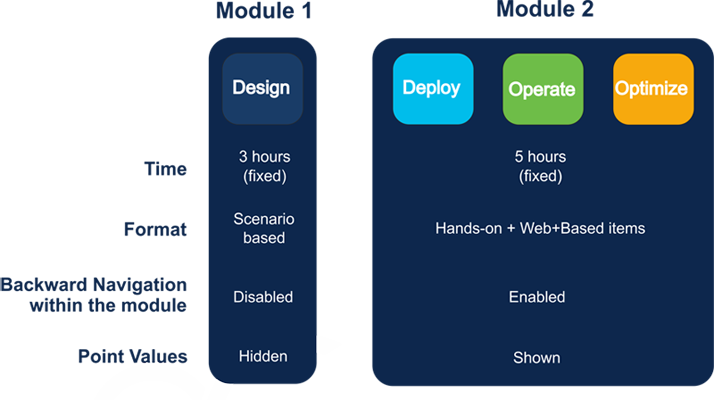
The 8 hours practical exam will assess candidate's skills through the entire network lifecycle of designing, deploying, operating and optimizing complex network scenarios. The exam consists out of 2 modules that are fixed in time and will be delivered in a fixed sequence:
The goal of this module is to measure ability to create, analyze, validate and optimize network designs, which is the base for all deployment activities. Candidates will need to:
- Understand capabilities of different technologies, solutions and services.
- Translate customer requirements into solutions.
- Assess readiness to support proposed solutions.
The module is scenario-based, without access to any devices. Candidates will be provided with a set of documentation required to discern before answering web-based items.
Examples of documentation include email threads, high-level design, network topology diagrams, customer requirements and restrictions, etc. Examples of web-based items include Drag-and-Drop, Multiple-Choice-Single-Answer, Multiple-Choice-Multiple-Answer, Dropdown items, etc.
During this module backward navigation will be disabled. As such, candidates will not have full visibility on all questions within this module. Points value(s) associated to each item are not displayed within this module.
In this module, candidates will be deploying, operating and optimizing network technologies and solutions.
- Deploy: Candidates will build the network according to the design specifications, customer requirements and restrictions. All steps required for a successful network implementation will be covered, including configuring, integrating and troubleshooting the commissioning of technologies and solutions, as per Exam Topics.
- Operate and Optimize: Candidates will operate and optimize network technologies and solutions. This includes monitoring network health, network performance, configure the network to improve service quality, reduce disruptions, mitigate outages, reduce operating costs, and maintain high availability, reliability, and security, as well as diagnose potential issues and adjust configurations to align to changing business goals and/or technical requirements.
This module provides a setup that is very close to an actual production network environment and will consist of both hands-on (device access) as well as web-based items. Where possible, a virtualized lab environment will be used in this module. Please refer to the equipment and software list for more detailed information.
During this module backward navigation will be enabled.
Candidates will have full visibility on all questions within this module. Points value(s) associated to each item are displayed within this module.
What is the passing score for CCIE Enterprise Infrastructure v1.0 Lab Exam?
Each module has both a minimum score and a pass score. Both minimum and pass scores are set on a per-module basis, based upon exam difficulty level.
- The pass score corresponds with expert level competence
- The minimum score is the absolute minimum score expected from an expert level candidate.
To pass the exam, candidates need to score higher than the aggregated pass score of both modules and score higher than the minimum score set on each of the modules individually
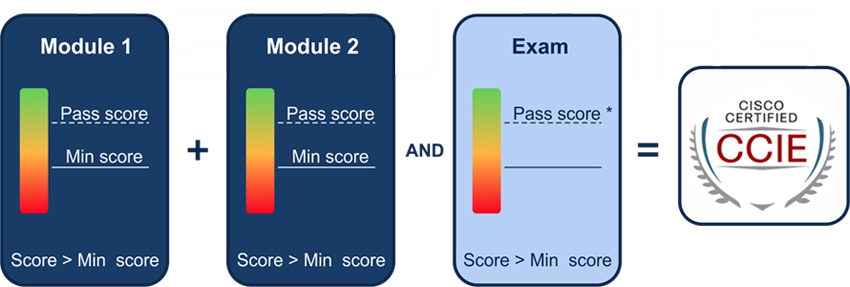
If candidates score less than the overall aggregated pass score of both modules OR score less than the minimum score set on 1 (or more) of the individual modules, they will fail the exam.
Upon passing the exam, candidates will not be provided any additional score details.
Candidates that fail the exam will be given a score report, indicating what module(s) they passed or failed. Additionally, candidates will be provided cumulative scoring percentages on a per domain level, across both modules.
Training Outline
Our CCIE training has been designed & developed adhering to latest Cisco Blue Print and includes all modules of CCIE Enterprise Infrastructure Exam
- Network Principles
- Understanding and Troubleshooting Layer 2
- IGP Routing – RIP, EIGRP, OSPF
- BGP
- IPv6
- VPN Technologies
- IP Multicast
- QoS
- Infrastructure Security
- IP Services
- Infrastructure Services
- Software-Defined infrastructure deployments
- Cisco SD-Access solutions and deployment
- Cisco SD-WAN solution and deployment
- Cisco SD-WAN edge deployment
- Infrastructure Automation and Programmability
- Automation and scripting
- Data encoding formats
- Interaction with vManage API
- Deploy and verify model-driven telemetry
For more in-depth course curriculum information, Please check CCIE Enterprise Infrastructure Training Course Curriculum Details
Hands-on Labs
- Switch administration , layer 2 protocols
- VLAN, trunking, EtherChannel, other LAN switching technologies
- IGMP, HDLC, PPP, reverse path forwarding
- IPv4 & IPv6 addressing and subnetting
- IPv4 protocol independent multicast
- Multicast source discovery protocol
- Static routing, default routing
- Administrative distance, passive interface
- VRF lite, filtering with any routing protocol
- Redistribution between any routing protocol
- Policy-based routing, sub-optimal routing, bidirectional forwarding detection
- Loop prevention mechanisms, routing protocol authentication
- RIPv2, neighbor relationship, loop free path selection
- Operations, EIGRP stub, load-balancing
- EIGRP [multi-address] named mode, EIGRP convergence and scalability
- OSPFv3 address-family support
- Path preference, OSPF convergence and scalability
- IBGP and EBGP, multiprotocol BGP
- Routing policies, AS path manipulations
- MPLS operations, basic MPLS L3VPN, encapsulation
- DMVPN [single hub], IPsec with pre-shared key
- IOS AAA using local database, device access control
- Control plane policing, switch security features
- Router security features, IPv6 first hop security, device management
- SNMP, logging, end-to-end QoS, troubleshoot QoS using MQC
- First-hop redundancy protocols, network time protocol (NTP)
- IPv4 and IPv6 DHCP, IPv4 network address translation
- IP SLA, tracking object, net flow, embedded event manager
- SD-WAN : Accessing the Lab Device
- SD-WAN : Reset vEdge Cloud Router
- SD-WAN : Remove vEdge Router from vManage Inventory
- SD-WAN : Add vEdge Router to vManage Inventory
- SD-WAN : Configure and Deploy Control-Plane Connectivity
- SD-WAN : Configure and Deploy an Overlay Network
- SD-WAN : Provision and Deploy vManage Templates
- SD-WAN : Provision and Deploy vManage Policies
- SD-WAN : Deploy Multi-Tenant vManage
What Devices are used during Hands-on Labs?
Our CCIE Enterprise Infrastructurev1.0 Training program provides the students with opportunity to have hands-on labs on CCIE Racks which are based on latest CCIE exam blueprints and in return boost their confidence to work with such high end devices efficiently in enterprise networks.
Virtual machines
- Cisco CSR 1000v Series Cloud Services Routers with Cisco IOS XE SD-WAN Release 16.12
- Cisco IOSv with Cisco IOS Software Release 15.8
- Cisco IOSv-L2 with Cisco IOS Software Release 15.2
- Cisco SD-WAN (vManage, vBond, vSmart, vEdge) Software Release 18.4
- Cisco DNA Center Release 1.3.1
Physical Equipment
- Cisco Catalyst 9300 Series Switches Release 16.12
Supporting virtual machines
- Cisco Identity Services Engine 2.6
- Microsoft Windows 10 Professional
- Ubuntu Desktop 18.04 LTS
Do you provide Placement Assistance, post completion of the training?
We are 100% committed to offer placement assistance to our students. Industry approved Resume Templates are provided to candidates as guidance to assist them in writing their resumes. We also provide students with FAQ interview questionnaire to help them prepare for their job interviews.
What is expected salary after the CCIE Enterprise Infrastructure v1.0 Training Course?
On an average a CCIE Enterprise Infrastructure v1.0 Certified Engineer with 5 plus years of experience gets salary in the range of INR 1,00,000 (1 Lac) per month in India.
After CCIE Enterprise Infrastructure training course, what is the Next Step?
Learning never stops. We always recommend CCIE Security v6.0 training. There is huge demand for CCIE Enterprise Infrastructure certified Engineers in market. These training and certification will establish your authority as an industry expert and provide you better career opportunities in the market.
Exam
Get Service Price In India
We Provide Services In
Stay Informed
Keep current with our new updated training & certifications, offers and more.